
Yeti
CSS-first successor to Foundation for Sites: one stylesheet, no build step, layouts that follow container queries. Still in alpha.
At a glance
Checked
- Pricing
- Free: the whole framework, under the FSL-1.1-MIT licence
- Licence
- FSL-1.1-MIT, source available rather than open source; each version becomes MIT two years after release
- GitHub
- github.com/foundation/yeti29.8k stars · 5.4k forks · written in JavaScriptLatest release v6.9.0, 27 Sep 2024From GitHub, updated at every build
- Made by
- Joe Workman, Foundation's maintainer
- Platforms
- Any web page, from npm, the jsDelivr CDN or copied files, in browsers at Baseline 2025 or newer
- Website
- foundationcss.com
What it’s good for
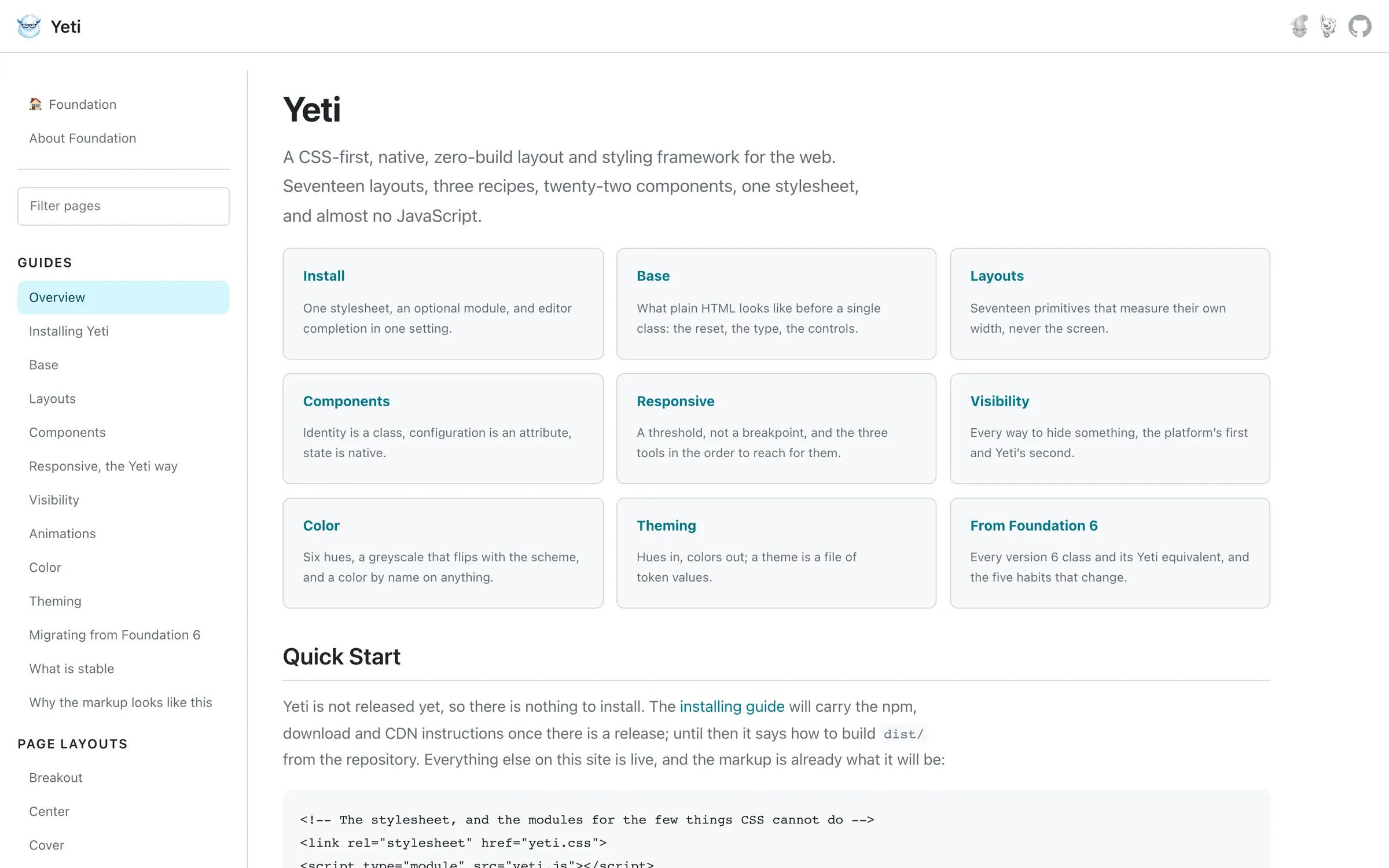
Yeti rebuilds Foundation for Sites around what browsers now do on their own. One stylesheet brings 17 layout primitives and 22 components, set up through data attributes instead of stacks of classes. Layouts react to the width of their container rather than to screen breakpoints, and native dialogs, popovers and details elements handle opening and closing, so very little JavaScript is involved.
Nothing needs compiling: the rules live in cascade layers, so any CSS you write wins without specificity fights, and a theme is just a second file of token values. Browser support starts at Baseline 2025. Yeti is still in alpha at 7.0.0-alpha.2, released on 4 November 2026 and installed from npm under the next tag. The Functional Source License lets you use it for your own and client sites but not inside a competing commercial product.
Alternatives to Yeti
All Frontend Design tools


Questions
- Is Yeti the same as Foundation for Sites?
- No. Yeti is a rewrite from scratch by Foundation's maintainer and starts at version 7. Foundation for Sites 6 stays on its own branch with bug fixes, and the Yeti docs have a migration guide pairing each version 6 class with its Yeti counterpart.
- Is Yeti open source?
- Not in the OSI sense. Its code is public on GitHub under FSL-1.1-MIT, which allows internal use and work for clients but forbids offering it in a competing commercial product, and each version converts to the MIT licence two years after it ships.