
DiceBear
Open-source avatar library with dozens of styles, generating deterministic avatars from a seed through an HTTP API or JS.
At a glance
Checked
- Pricing
- Free: the open source libraries for JavaScript, PHP, Python and other languages, and the CLI, under MIT
- HTTP API: free for non-commercial use, up to 50 SVG or 10 PNG, JPG, WebP or AVIF requests a second; host your own instance for commercial use
- Licence
- Code under MIT, open source. Of the 61 avatar styles, 42 are CC0, 14 are CC BY 4.0 and need credit, one is MIT, and four by Pablo Stanley follow his own free terms
- GitHub
- github.com/dicebear/dicebear10.1k stars · 446 forks · written in VueLatest release v10.7.0, 26 Aug 2026From GitHub, updated at every build
- Made by
- Florian Körner
- Platforms
- An HTTP API, libraries for JavaScript, PHP, Python, Rust, Go, Dart and C#, a CLI, a Figma plugin and an online editor
- Website
- dicebear.com
What it’s good for
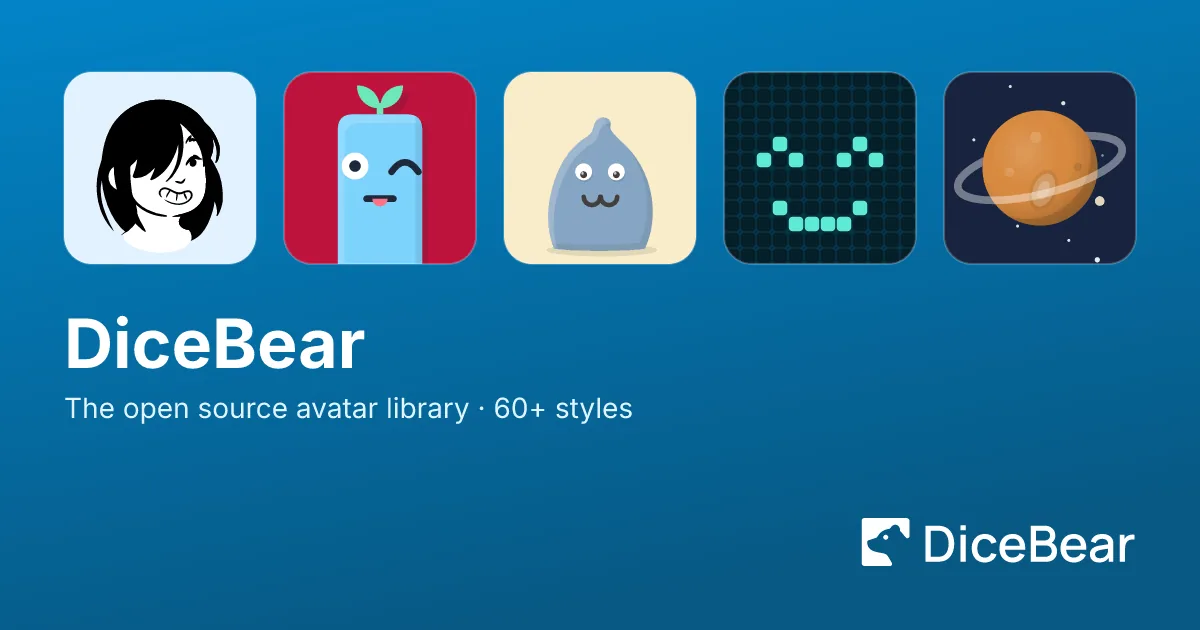
DiceBear turns any string, such as a user id or an email, into the same avatar every time, so a product can show a face before people upload a photo. It offers 61 styles, from pixel art and initials to illustrated characters, and you can request them as an image URL from the HTTP API, render them with the JavaScript, PHP or Python libraries, run the CLI, or build one by hand in the online editor and Figma plugin.
The code is MIT, but each style carries its own licence: 42 are CC0, while 14, such as Adventurer and Micah, are CC BY 4.0 and need a credit to their artist. The hosted API is free for non-commercial use within rate limits; commercial projects should run their own instance.
Alternatives to DiceBear
All Illustrations tools
Boring Avatars
Six abstract SVG variants from a name and palette, as a React component or a paid hosted API.
Illustrations

Open Peeps
The hand-drawn CC0 library behind the DiceBear Open Peeps style, mixed by hand in Figma, Sketch or XD.
Illustrations

Notion Faces
Builds one hand-drawn portrait in the Notion style at a time by picking features, then downloads it.
Illustrations

Questions
- Can I use DiceBear avatars commercially?
- Yes, but check the style. CC0 styles need no credit and CC BY 4.0 styles need a credit and a licence link. The public HTTP API is meant for non-commercial use, so commercial projects should host their own.
- Does the DiceBear API have a rate limit?
- Yes. The public API accepts up to 50 requests a second for SVG and 10 a second for PNG, JPG, WebP and AVIF, which are capped at 256 by 256 pixels. Going over returns an HTTP 429 error.